From stray to stay
The hospice was set up as a sanctuary and not as a rehoming centre. However, we do often have a small number of dogs looking for forever homes (and occasionally cats).
The Penny Jones Animal Hospice cannot guarantee that any animal profiled on our website (or Facebook page) will eventually be suitable for a prospective adopter, but we do promote those who we believe are 'ready for a domestic home'. The animals are only promoted for adoption after they have been assessed, but we are unable to match a dog with a prospective adopter with absolute certainty as each has very differing needs and each dog can change hugely once in a new environment.
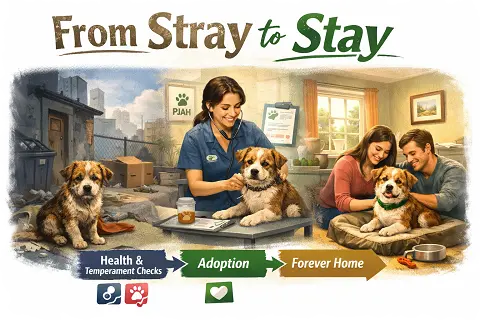
All PJAH dogs are given health and temperament assessments. This gives us an insight into their character and enables us to make a considered decision as to which type of home would be best for the animal. However, a pet's behaviour can alter once in a new home. The Penny Jones Animal Hospice cannot be held responsible for the temperament of any animal once it has been rehomed: we can only assess an animal by the behaviour it displays whilst in our care. We can socialise our dogs with other sanctuary dogs and with our volunteers; we can walk our dogs in our own fields and along the roads local to us; we can assess how clean our dogs are in their kennel areas and can assess how they react to our other animals. We have our limitations but we will always be honest with you about our animals.
All visits to the sanctuary are by appointment only. We understand this can be disappointing: however, studies show that visitors walking around the site can cause distress to the animals, affecting their mental and physical health. For our animals’ welfare, we restrict general access to our volunteers only (although we do aim to hold two public Open Days every year, usually May/June and September/October).
Please contact us if you are looking to adopt a companion. We welcome enquiries from prospective adopters and aim to respond within 24 hours. Your companion may be waiting at the hospice, just for you....

Dogs
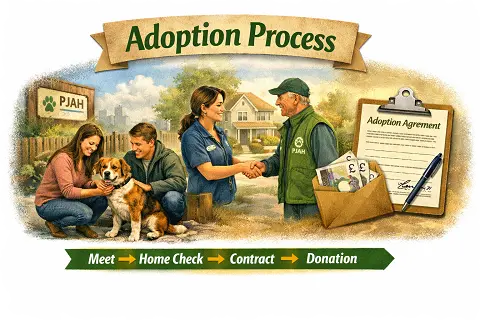
If you are a potential adoption match for a specific dog, you will be invited to make an appointment to meet the dog at the sanctuary and we will arrange to do a home check. If you already have a dog(s), we will ask you to bring them to meet the PJ dog so that we can assess how the dogs get on. Depending on the dog(s), you might be asked to visit us more than once. On average the process can take up to three weeks, dependent on the availability of our volunteers.
After all the introductions and checks are complete you will be asked to sign an adoption contract. At this stage you will be able to make a donation to the charity and take your new companion home. When you adopt a PJ dog we ask for a minimum £100 donation towards rescuing another dog (each dog transport costs us around £250).
We try our best to ensure the dog you adopt is a fantastic match for you - however, it is in everyone's best interests that the dog is returned within the first two weeks if you feel the dog is not the right one for you. If there are behaviour or settling issues we will aim to offer support where practicable, giving advice based on our own experiences while your dog adapts to a new home. We offer lifetime backup to our dogs, and will do our very best to help you if your circumstances change and you are no longer able to care for your PJ dog: this may mean we take the dog back into our care at the sanctuary, but other solutions can be offered if we have no kennel spaces available. We urge you to tell us about any problems you are having with your newly adopted dog so that we can attempt to resolve the issue. We firmly believe that "a problem shared is a problem halved"!
The dogs at the sanctuary are with us for varying lengths of time and we form a strong bond with them from the moment we know they are destined to travel to us - we care deeply about what happens to them. When you adopt an animal from us, we would love you to join our Facebook group 'Penny Jones Animal Hospice Friends' and update us on how your adopted dog is getting on.
All our imported dogs are tested for foreign diseases, including Brucella Canis. Some vet practices are now asking for a negative Brucella Canis test result prior to accepting a 'foreign' dog for treatment, and will want to conduct their own testing. Boarding kennels are also starting to ask for results.

We do not usually put our dogs into foster homes. We would not agree to one of our dogs being shared between two households. Generally, we do not rehome our dogs to homes with young children (there is the occasional exception!) or to homes out of the area (as we would not be able to provide adequate rescue backup). Our dogs are not cat tested unless this is stated specifically prior to adoption.
All animals are rehomed at our discretion and we reserve the right to refuse a prospective adopter without giving a specific reason. Our dogs are matched to an adopter based on the most suitable applicant and not on a 'first come, first served' basis. We are sorry, but we are not able to reserve an animal until after the checks and introductions have been completed – however, we always welcome expressions of interest, even if the animal has not yet arrived at the sanctuary. Each animal is completely unique and we are dedicated to finding the best environment for each one, which does mean that many remain at the sanctuary for life due to the type of dogs that we prioritise to rescue. All of our long term residents have a rescue space for life and often arrive here as they are too old, too ill, too traumatised, have a bite history, or are at risk of being euthanised for one reason or another.
Cats
Just occasionally, we get asked to help a cat to find a new home. If you are looking for a cat to adopt, please get in touch as we might be able to help.
A word from Toto the Ambassadog
Welcoming a new dog into your home
I wanted to explain something to you about when I was stuck in the shelter abroad. You see, I was lucky because it was a nice place where the rescuers looked after me because I was found injured on the streets. The rescue team got to know me because I was so poorly and needed lots of care. But what they didn’t know about me is what my life was like before I was rescued.
Now that I live at the hospice, I know what it is like to have a comfortable warm bed, shelter from the rain, toys, food, treats, cuddles, friends and more cuddles. I now know what it is like to be loved and to feel safe. I have been through so much but it has made me wise and it means I can help all the new animals who come to live here. That’s why I’m a great Ambassadog.
If any of you nice people adopt one of my friends, don’t forget that you don’t know what has happened in their past lives. Some dogs arrive at a gallop and are ready for everything life has to offer, others need a slow little tootle to adapt.
Here are a few tips about those friends that need to tootle, rather than gallop.
- All of us deserve love and a forever home – sometimes with a sofa, sometimes just a space to relax and feel safe.
- All of us deserve our own special human family.
- All of us will reward you ten-fold with our love and devotion to our new family.
- All of us would like to become your best friend and the friend you can rely on.
- All of us will make you laugh and might sometimes make you cry too.
- All of us deserve TIME to adapt, TIME to learn, and TIME to become the dog we should be.
- With TIME, you will learn what fantastic loyal, devoted and appreciative companions we are.
BUT PLEASE REMEMBER
- Many of us haven’t ever had a fancy dog bed before – we are more used to sleeping on hard concrete, a wooden pallet, a shallow hollow in the dirt, or a pile of discarded rubbish.
- Some of us might have been poisoned in our past lives and, as survivors, we might be suspicious of food that we aren’t familiar with.
- Many of us are used to scavenging for our food. When we are fed regularly, some of us enjoy our food so much that we can’t stop eating and we get a little bit round.
- Some of us think ALL food belongs to us and we become determined to get at it, no matter what it is or where it is.
- Sometimes we forget that the next meal isn’t far away and then, when it comes, we get a bit possessive over the food dish and might turn a bit 'gremlin'.
- A great many of us will have seen our friends being hurt and killed by humans. Some of us are haunted by our memories and we might have nightmares.
- Some of us have learnt to bark and act aggressively when startled (that’s how we managed to survive the competition on the streets and shelters), so treat us gently and talk to us.
- Some of us may try to escape just because we are frightened and don’t know what is going to happen to us – we are in survival mode. Your secure garden may not be as secure as you think for a determined dog. Think UNDER, think OVER, think THROUGH.
- Some of us prefer a harness to a collar because the collar reminds us of when we were treated badly by humans and had the dog catching pole around our neck.
- Consider leaving the collar/harness and lead on for the first few days, as a trailing lead is easier to get hold of if you need to, rather than grabbing an already frightened dog.
- Some of us might be safer if you keep us on a lead in the garden until we are more settled.
- FORGIVE US if we pee or poop where we aren’t supposed to. We need time, patience and kind words rather than anger and shouting.
- Some of us become frightened if we leave the security of our home.
- Some of us take many months to learn to play with a toy or roll over for a tummy rub.
- Some of us need both a harness and a lead when going out on a walk so that we can’t escape. Sometimes we actually feel more secure with a harness/lead than without one - and that’s because we walk close to you and, if spooked, we can’t run away. We don’t all HAVE to have off lead exercise, especially if you have a nice garden at home for us to play in. We would rather be safe with you than escape and be lost and frightened without you.
- Some of us get spooked by the most unexpected things: some of us have never seen a television, or heard a washing machine, or walked on sand, or paddled in water, or been taken for a walk before.
- Some of us are frightened by large open spaces or scared to go through a gate or a door.
- Some of us are frightened when we are left on our own.
- Some of us are terrified of strangers or children because they threw stones at us and shouted at us to make us go away.
BUT - G.T.T.
GIVE THEM TIME
Give us time and we will adapt. Give us time and you will reap the rewards.